Black Forest Supplements · Nootropic Pouches launch · Slot 01 · Value 1
Dependence Nation
Product-free and format-free. Built on the three value blogs with the most comments per reader in our launch arcs: The Remedy for Everything but Death (44 per 100k delivered), What Dr. Sumi Found (38), Heart Attack Nation (37). Publishes at /blogs/noticias/; the slot-01 email lands here. Draft v2, Oct 26.
The article
Dependence Nation
Baltimore, 2010. Forty-one studies and one question: does nicotine actually make you sharper? The answer is the most profitable trade in America, and almost nobody selling it wants the second half read out loud.

Baltimore, 2010. Forty-one studies. One question.
There is a reason almost nobody who reaches for nicotine to get through the afternoon has heard the name Stephen Heishman.
In 2010, at the National Institute on Drug Abuse’s research center on Bayview Boulevard in Baltimore, Heishman and two colleagues set out to settle something the people selling nicotine never had a reason to pay for. They gathered every double-blind, placebo-controlled laboratory study on nicotine and human performance published between 1994 and 2008. Forty-one of them. Then they asked one question, cleanly: does nicotine actually make you sharper?
Most people who use nicotine are never far from their last dose. When a smoker feels sharper after a cigarette, you cannot tell whether the nicotine improved him or simply ended the fog of going without. Heishman’s team pulled those two apart.
The answer came back yes.
Across the forty-one studies, nicotine measurably improved six things: fine motor control, alertness, how fast and how accurately attention locks on, how fast attention shifts, short-term memory, and working memory. The effects were modest. They were also real, and in the authors’ own words they were “not confounded by withdrawal relief.” (Heishman, Kleykamp & Singleton, Psychopharmacology, 2010)
Nicotine works.
In 2023, 48.6 million American adults, nearly one in five, used a tobacco product, e-cigarettes included, by the CDC’s own count. Smoking itself has fallen from 42.4 percent of adults in 1965 to 11.6 percent in 2022, the lowest level in sixty years. The total did not fall with it. Between 2017 and 2023, 6.8 million fewer adults smoked only cigarettes, and 7.2 million more used only e-cigarettes. In the CDC’s own words, tobacco product use among adults “has not changed since 2017.” (Arrazola et al., MMWR, 2025)
The cigarette lost its customers. Nicotine kept every one of them.
Heishman’s finding is the half of the story the warning labels never told those forty-eight million people, and the half that keeps the machine running. The other half was published a year earlier, at Yale.
New Haven, 2009. Thirty people. Seventeen hours.
At the Yale School of Medicine, Emily Harrison, Sabrina Coppola and Sherry McKee took thirty daily smokers and tested each of them three times: once with no time away from nicotine, once after five hours without a cigarette, and once after seventeen. Same people, same two tests. One measured sustained attention. The other measured self-control, the ability to hold back when you meant to hold back.
The longer they went without, the worse they did. Reaction times slowed. Errors went up. Answers came out uneven, fast one moment and slow the next. They made more of the mistakes where you act when you meant to wait. Seventeen hours was the worst of the three. (Harrison, Coppola & McKee, Experimental and Clinical Psychopharmacology, 2009)
If your last one was at nine last night, two o’clock this afternoon is hour seventeen.
When John Hughes at the University of Vermont reviewed 120 studies on what happens when people stop using tobacco, “difficulty concentrating” was on his list of the valid withdrawal symptoms, peaking in the first week (Nicotine & Tobacco Research, 2007). The Centers for Disease Control puts it on its own list of seven in plainer words: “Having a hard time concentrating.”
Put Baltimore and New Haven side by side and you have the whole trade. Nicotine sharpens you a little. Going without dulls you, measurably, by the next afternoon. So part of the sharpness every dose delivers is sharpness the last one took away.

The man at his desk at two in the afternoon
He is in his mid-forties, good at his job, the kind of man who prides himself on not needing much. His last dose was around nine last night.
The morning is fine. Coffee, email, a meeting he runs well. By two the screen starts to swim. He reads the same paragraph three times. Somebody asks him a question and the answer takes a beat too long to arrive. He is irritated and cannot say at what.
He reaches for it. Ten minutes later the fog lifts, the paragraph makes sense, and he gets the rest of the afternoon done. He tells himself what millions of men tell themselves at that hour: this is what helps me focus.
What he felt was real. A good part of it was the end of hour seventeen.
Tomorrow at two, it will happen again. That is not a weakness in him. It is what the Baltimore and New Haven data say the trade is built to do.
Dependence, sold as productivity.
America was told the cigarette was dying
For twenty years the story has been that tobacco is on its way out. The ashtrays left the restaurants. The ads left television. If you ever smoked and stopped, you were told the problem was behind you. If you never smoked, you were told it was never yours.
On October 21, Philip Morris International filed its third-quarter results with the Securities and Exchange Commission. In the United States it shipped 3.2 billion doses of its smoke-free nicotine in three months, up 4.2 percent on a year ago. The same filing says the company is repackaging that brand to “optimize [its] price premium.” And its chief executive, Jacek Olczak, credited “the exceptional results of our combustible business.”
Combustible is what a cigarette company calls cigarettes when it is talking to the people who own it. The smoke-free side is growing. The cigarette side is exceptional. Nobody lost a customer.
That is because the customer was never buying the smoke. He was buying the nicotine. Smoke was the delivery system, and delivery systems get replaced.
In January 2025 the Food and Drug Administration authorized the first smoke-free nicotine products of this kind for the American market, because they contain “substantially lower amounts of harmful constituents than cigarettes.” The same release says the authorization “does not mean these tobacco products are safe, nor are they ‘FDA approved.’”
So the smoke left. What stayed? A 2025 review from the University of Ottawa Heart Institute pooled three trials and found that a single 4-milligram dose of this smoke-free nicotine delivers 91.73 percent of a cigarette’s total nicotine exposure (Drug and Alcohol Dependence Reports, 2025). Nine-tenths of a cigarette, with no smoke to tell anyone it is there.
- ❌ 48.6 million American adults using a tobacco product in 2023, the same share as 2017 (CDC)
- ❌ 480,000 American deaths a year from smoking (CDC)
- ❌ $600 billion in costs in 2018, the last year the CDC priced it, including nearly $185 billion in lost productivity (CDC)
- ❌ 3.2 billion doses of smoke-free nicotine shipped in the US in three months (Philip Morris International, SEC filing, Oct 21 2026)
- ❌ 91.73% of a cigarette’s nicotine in one 4-milligram dose (University of Ottawa Heart Institute, 2025)
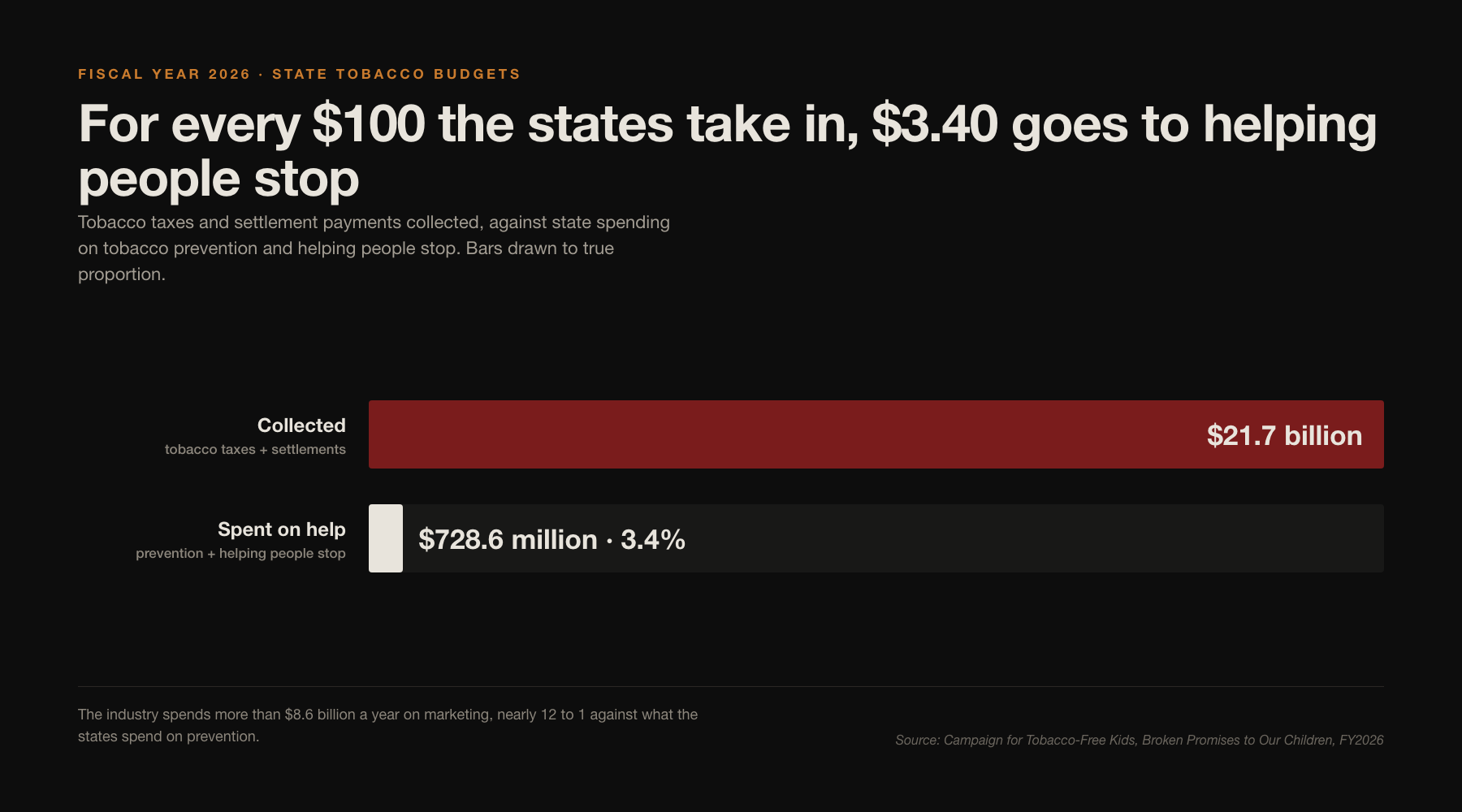
- ❌ $21.7 billion collected by the states this year from tobacco taxes and settlement payments (Campaign for Tobacco-Free Kids)
- ❌ 3.4% of it spent on preventing tobacco use and helping people stop (Campaign for Tobacco-Free Kids)
- ❌ $8.6 billion a year on tobacco marketing, nearly 12 to 1 against that budget (Campaign for Tobacco-Free Kids)
A product sold for focus costs this country nearly $185 billion a year in lost productivity.

The $21.7 billion reason nobody is paid to tell you this
A forty-one-study finding from a federal lab ends up on a supplement company’s blog instead of on the packaging because of six links, and every one of them is paid.
- The customer comes back every day. That is what a daily habit is. Philip Morris International shipped 3.2 billion doses in three months, and told its shareholders it is protecting the price premium.
- The states take their cut. $21.7 billion this fiscal year from tobacco taxes and settlement payments. $728.6 million of it, 3.4 percent, goes to preventing tobacco use and helping people stop. That is 22 percent of what the CDC recommends the states spend.
- The industry outspends the help. More than $8.6 billion a year on marketing. Nearly twelve dollars for every dollar of prevention.
- The regulator approves the safer delivery, and says so carefully. Fewer harmful constituents than a cigarette. Not safe. Not “FDA approved.” The nicotine itself is not what the authorization was about.
- The court already ruled on the last version. In 2006 a federal court found that the major cigarette makers “had for decades conspired to deny the health effects of smoking.” It ordered them to publish corrective statements, including one “about designing cigarettes to enhance the delivery of nicotine,” and the appeals court upheld the remedy because “requiring Defendants to reveal the previously hidden truth about their products will prevent and restrain them from disseminating false and misleading statements” (United States v. Philip Morris USA, D.C. Cir., 2017).
- End of the line. Every link is paid while the man at his desk keeps coming back at two in the afternoon. Not one of them is paid when he is sharp without it.
You do not need a conspiracy to explain why nobody prints the Yale result on the packaging. You only need to follow who gets paid at each step. The same industry a federal court ordered to reveal the hidden truth about one product is the industry selling the next one.
And if you have ever told yourself you need it to focus, you are not weak and you are not stupid. You are reading the result of a trade that was studied in detail, by people with far more money than you, for far longer than you have been alive.
The next customer is in middle school
There is one more number in the FDA’s January 2025 release, printed in the same document that authorized it. In 2024, 1.8 percent of American middle and high school students said they were currently using nicotine products of this smoke-free kind.
That is how the same trade starts. A kid who finds out at fifteen that nicotine helps him concentrate in class will find out at sixteen what the afternoon feels like without it. Baltimore and New Haven do not stop applying because the user is young.
His grandfather’s habit came with a smell, a cough and a warning label in black and white. His comes with none of those. It fits in a pocket, it is sold as focus, and every link in that chain of six is paid when he reaches for it.
Who gets paid when you can’t focus
Philip Morris International is paid when he reaches for it at two in the afternoon. The states are paid on every one. A marketing budget of more than $8.6 billion a year is paid to make sure he reaches again tomorrow. And at the far end of the chain, medicine is paid too: more than $240 billion in American health care spending on smoking in 2018, by the CDC’s count.
The man in the middle is paid nothing. He pays for all of it: the price premium, the tax, the lost afternoons, and for millions before him, the bill at the end.
That is the system we built Black Forest to stand against. It earns more when Americans are sick, tired and dependent than when they are well, and it has every reason to keep them that way. Our purpose is the opposite: to help Americans live better, and to break free from a system that profits from their sickness.
I am not going to tell anyone to stop. That choice belongs to the man making it, and the programs paid to help him get 3.4 cents of every dollar the states collect. I will tell him what the research says, because nobody else in this chain is paid to.
Heishman’s forty-one studies prove that attention can be sharpened. Nothing in them says sharpness has to come with a hook in it. The hook is a business decision.
We have spent this year on focus with nothing hooked to it, built from research that has been published, measured and peer-reviewed for decades, and never once put where a man at his desk at two in the afternoon could read it. It is not ready to show you today. When it is, the people on our list hear first.

His father’s habit had a smell. His doesn’t.
You could find your father’s habit on his jacket, in the car, on his hands. Everybody knew what it was. In 2006 a federal court ordered the companies to say what they had known all along.
His son’s habit has no smell. Nobody sees it. It is shipped by the billion, taxed on the way through, and sold to him as focus.
His father got the truth from a court order, decades late. You are getting it today, from the research itself.
Get on the list above so you do not miss what comes next. And reply to tell me what gets you through two in the afternoon. I read every one.
To your health,
Antonio
CEO, Black Forest Supplements
Editorial, for general education. Not medical advice. This article describes published research and public records; it does not describe or promote any product. Sources: Arrazola et al., MMWR 2025 (CDC); Heishman, Kleykamp & Singleton, Psychopharmacology 2010 (National Institute on Drug Abuse); Harrison, Coppola & McKee, Experimental and Clinical Psychopharmacology 2009 (Yale School of Medicine); Hughes, Nicotine & Tobacco Research 2007 (University of Vermont); CDC, 7 Common Withdrawal Symptoms and Health and Economic Benefits of Tobacco Use Interventions; Philip Morris International Q3 2026 earnings release, Form 8-K Exhibit 99.1, Oct 21 2026; FDA press announcement, Jan 16 2025; Heshmati et al., Drug and Alcohol Dependence Reports 2025 (University of Ottawa Heart Institute); Campaign for Tobacco-Free Kids, Broken Promises to Our Children, FY2026; United States v. Philip Morris USA Inc., No. 16-5101 (D.C. Cir. 2017).
Sources, each read Oct 21 to 26 2026
- Heishman, Kleykamp, Singleton. Meta-analysis of the acute effects of nicotine and smoking on human performance. Psychopharmacology 2010 (NIDA)
- Harrison, Coppola, McKee. Nicotine deprivation and trait impulsivity affect smokers' performance on cognitive tasks of inhibition and attention. Exp Clin Psychopharmacol 2009 (Yale)
- Hughes. Effects of abstinence from tobacco: valid symptoms and time course. Nicotine Tob Res 2007 (University of Vermont)
- Arrazola, Husten, Cornelius, Armour. Notes from the Field: Tobacco Product Use Among Adults, United States, 2017-2023. MMWR 2025;74(7):118-21 (CDC)
- CDC. 7 Common Withdrawal Symptoms
- CDC. Health and Economic Benefits of Tobacco Use Interventions ($600B, $185B lost productivity, 480,000 deaths)
- Philip Morris International. Q3 2026 earnings release, Form 8-K Exhibit 99.1, Oct 21 2026 (SEC EDGAR)
- FDA. Marketing authorization press announcement, Jan 16 2025 (incl. 2024 NYTS youth use)
- Heshmati et al. Nicotine pharmacokinetics vs smoked tobacco, systematic review and meta-analysis. Drug Alcohol Depend Rep 2025 (University of Ottawa Heart Institute)
- Campaign for Tobacco-Free Kids. Broken Promises to Our Children, FY2026
- United States v. Philip Morris USA Inc., No. 16-5101 (D.C. Cir., Apr 25 2017)
Philip Morris International reports its shipments in a unit word reserved for the Oct 29 announcement; this article says doses, one unit to a dose. The brand is not named because canon bans it in copy. Philip Morris International was not a party to the 2006 case (it separated from Altria in 2008), so the article says “the same industry,” never “the same company.”